Important Dates - Summer/Fall 2026 Co-op approval
It is best for students to submit their Experience at least 10 business days prior to their anticipated start date to allow enough time for Experience Form processing. Dates are subject to change.
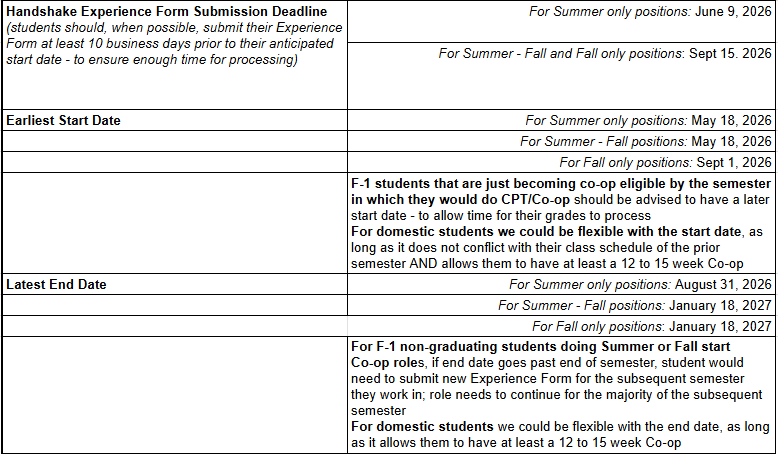
F-1 students can refer to the Academic Calendar and CPT webpage for more information.
PROCESSING YOUR OFFER:
1. Visit Njit.JoinHandshake.com and login.
2. Click Career Center > Experiences > Submit Experience.
3. You will need the following information to fill out your Experience Form:
- Faculty Co-op Advisor (click here to find your advisor).
- Your co-op course number (click here to find your Co-op course number based on your major and whether this would be your 1st or 2nd Co-op course).
- Your Job Offer (including position title, Supervisor's name and contact information (email address and phone number), Start date and end date of the position, job description of the position’s tasks/responsibilities (must relate to student’s major and/or career objectives), number of hours student will be working per week (40 hours full-time maximum), Salary).
- PhD students' offer letters should have explanation of how position would help in collection of data for the student's PhD research and dissertation.
- Your supervisor’s contact information (or that of an HR representative)
- Three learning objectives for your co-op course. (Click here for tips and sample learning objectives you can use.)
- A digital copy of your unofficial transcript.
NEW FOR F-1 STUDENTS - International Students are required to complete the CPT Curricular Practical Training Canvas course and upload a Certificate of Completion to their Handshake Experience Form before OGI will review your Experience for approval. Enroll in the CPT Course here
4. When you start to fill the Experience Form, you will need to enter your contact information, major, information about your Co-op job offer (including employer name and location), and the information listed in Step 3. You should upload your offer letter and unofficial transcript as attachments to your Experience Form [Go to the “Overview” page and under attachments, select “New Attachment” to upload your offer letter and an unofficial transcript]
5. Once you have submitted your Experience Form for approval, it will go through the following approval chain: Supervisor > Faculty Co-op Advisor (the professor for your co-op class) > Career Development Services > Office of Global Initiatives (if required for CPT work authorization).
PhD students would also need to have their Experience Form approved by their Dissertation Advisor and Office of Graduate Studies
6. When your Experience Form is approved, you are cleared to begin your co-op.
F-1 students filling out the Experience Form to get CPT work authorization cannot start their co-op until their Experience Form has been fully approved, and they have received their CPT work authorization (and I-20)
COMMUNICATION AFTER APPROVAL:
Once the co-op has been approved, you will receive a confirmation email from Handshake. Your employer should also reach out to send you a list of requirements prior to your first day. If you don’t receive more information from your supervisor, please reach out to them directly. Keep an eye out for communication from your Faculty Co-op Advisor for any information about what is required for your Co-op course.
Click here to read the most frequently asked questions that students have before they start a co-op.
If you have any questions about the NCE Co-op program, you are welcome to contact Nayelli Perez - Director, Undergraduate Engineering Co-op at nayelli.perez@njit.edu. Students who want to go over their Co-op job search can make an appointment with their career advisor in Handshake, and can find their career advisor at this link.
Tips on how to write your Learning Objectives can be found at this link.
Here are some Learning Objective examples (based on major):
Biomedical Engineering:
-
Objective: Gain Medical Device Design Proficiency
- To become proficient in designing, testing, and iterating medical devices, adhering to industry regulations and safety standards.
- To contribute to the development of innovative medical solutions by applying principles of biomechanics, biomaterials, and medical imaging.
-
Objective: Develop Clinical Research and Testing Skills
- To actively participate in clinical research studies and in-vitro testing of medical products, gathering data, and analyzing results.
- To collaborate with medical professionals, ensuring the practical application of biomedical engineering solutions in a clinical context.
-
Objective: Enhance Regulatory Compliance Understanding
- To gain knowledge and experience in regulatory affairs related to medical devices, including FDA submissions and quality control.
- To ensure that biomedical engineering projects align with industry regulations, standards, and quality assurance processes.
Chemical Engineering:
-
Objective: Develop Chemical Process Design Expertise
- To gain proficiency in designing chemical processes, including reaction kinetics, separation techniques, and safety protocols.
- To use process simulation software to model and optimize chemical processes.
-
Objective: Enhance Laboratory and Quality Control Skills
- To actively participate in chemical experiments, data analysis, and quality control procedures in a laboratory or production environment.
- To ensure the quality and safety of chemical processes and products through rigorous testing and analysis.
-
Objective: Focus on Environmental and Sustainable Practices
- To work on projects that emphasize green chemistry and sustainable chemical engineering practices, such as waste reduction and environmentally friendly processes.
- To learn about regulatory compliance in chemical engineering, including environmental regulations and safety standards.
Civil Engineering:
-
Objective: Improve Infrastructure Design Skills
- To gain proficiency in designing civil infrastructure projects, such as roads, bridges, and buildings, while considering factors like safety, sustainability, and cost-effectiveness.
- To use computer-aided design (CAD) software to create detailed construction plans and simulations.
-
Objective: Enhance Project Management Competencies
- To learn project management methodologies, including budgeting, scheduling, and resource allocation, to successfully manage civil engineering projects.
- To collaborate with multidisciplinary teams and contractors to ensure project delivery on time and within budget.
-
Objective: Develop Environmental Sustainability Expertise
- To focus on sustainable and environmentally friendly engineering practices by incorporating concepts like green building and renewable energy into civil engineering projects.
- To work on projects that prioritize minimizing the environmental impact and enhancing community resilience.
Electrical Engineering:
-
Objective: Master Electronics Design and Testing
- To gain proficiency in designing electronic circuits and systems, including PCB design, and testing them for functionality and reliability.
- To work with advanced electronics design tools, such as CAD and simulation software.
-
Objective: Gain Power Systems Engineering Skills
- To participate in the design and analysis of electrical power systems, including distribution networks and renewable energy integration.
- To learn about energy efficiency and grid management while working on real-world power projects.
-
Objective: Improve Control Systems Knowledge
- To become adept at designing control systems for automation and robotics applications, including feedback control and instrumentation.
- To collaborate on projects that involve real-time control and automation of industrial processes.
Environmental Engineering:
-
Objective: Gain Expertise in Environmental Impact Assessment
- To conduct environmental impact assessments for various projects, evaluating potential environmental risks and proposing mitigation strategies.
- To understand the regulatory frameworks related to environmental impact assessments.
-
Objective: Develop Water and Wastewater Treatment Skills
- To design, implement, and optimize water and wastewater treatment processes, focusing on water quality improvement and environmental protection.
- To work with cutting-edge technologies and treatment systems in a real-world context.
-
Objective: Enhance Sustainability and Remediation Practices
- To focus on sustainable environmental engineering practices, including remediation of contaminated sites and sustainable waste management.
- To actively contribute to projects that prioritize environmental sustainability and long-term ecological health.
Industrial Engineering:
-
Objective: Improve Process Optimization Skills
- To gain proficiency in optimizing manufacturing and production processes to enhance efficiency, quality, and cost-effectiveness.
- To use industrial engineering tools and methodologies such as Lean Six Sigma to identify and eliminate process inefficiencies.
-
Objective: Enhance Supply Chain and Logistics Management
- To learn about supply chain management, inventory control, and logistics optimization, ensuring timely and cost-effective delivery of products.
- To work on projects that involve streamlining the flow of materials and information within organizations.
-
Objective: Develop Data Analysis and Decision-Making Expertise
- To use data analytics and statistical techniques to make informed decisions related to process improvement, resource allocation, and quality control.
- To actively contribute to data-driven decision-making in an industrial engineering context.

The Chem-E Car Competition is an annual collegiate competition that challenges students to design and construct a small, chemically-powered car. The competition is organized by the American Institute of Chemical Engineers (AIChE) and is typically held as part of the AIChE Annual Student Conference or the AIChE Annual Meeting.
The goal of the Chem-E Car Competition is to encourage students to apply their knowledge of chemical engineering principles to design a car that can safely carry a specified load over a certain distance. The unique aspect of the competition is that the car must be powered by one or more chemical reactions rather than traditional fuel sources such as gasoline or electricity.
Each team participating in the competition must design and build a car that meets certain constraints and requirements provided by the competition organizers. These constraints may include limitations on the size and weight of the car, the maximum amount of reactants used, and safety regulations. The specific details of the competition can vary from year to year.
During the competition, teams present their cars to a panel of judges and demonstrate their car's ability to carry a specified load. The distance the car must travel is usually not disclosed until the actual competition day, adding an element of unpredictability. The teams must calculate and control the chemical reaction(s) in their car to stop it as close as possible to the finish line without going over.
The Chem-E Car Competition encourages students to think creatively, apply engineering principles, and develop practical solutions for real-world challenges. It provides an opportunity for students to showcase their technical skills, teamwork, and problem-solving abilities within the field of chemical engineering.
- Team Email: chem-e-car@njit.edu
You are invited to join the NCE Co-op Mentor Match Program!
This mentorship program has been established to connect NCE undergraduate freshmen participating in the co-op track with professional alumni mentors.
Each mentee will be matched with a mentor. Students are generally matched with a mentor whose professional background or prior mentorship experience aligns most closely with the mentee's field of interest.
Joining Co-op Mentor Match offers you the opportunity to:
- Share your experience and advice with current students who are seeking or are currently enrolled in a co-op experience;
- Participate in a 3-month structured mentorship program for co-op students;
- Post special co-op opportunities just for NJIT students;
- Participate in co-op-only networking events to recruit co-op students to your company; and participate in alumni panel discussions about current topics in your industry.
Important things to note:
- Students are undergraduate engineering freshmen
- Matching will be based on a combination of factors including preferences selected by mentees, overlap in interests and background identified in program registration questions.
- You will receive an email notification once you are matched with your mentor or mentee. Please respond promptly.
Orientation Schedule
- Online orientation option A for mentors will take place on Tuesday, August 13.
- Online orientation option B for mentors will take place on Thursday, August 15.
Mentorship Schedule
- Your first virtual meeting will take place the week of September 16.
- Your second virtual meeting will take place the week of October 21.
- Your final meeting will take place the week of November 18.
- Your student mentee will reach out to schedule dates during those weeks that work for both of you.
Format
All meetings will take place virtually in Highlander Nation. Meetings will be automatically recommended through the system.
Please indicate your interest below!
Expiration Date
Primary Link Text
Become a partner
Primary Link URL
#
Secondary Link Text
Second link
Secondary Link URL
#
Why partner with NCE?
There are numerous ways to directly connect with NCE students. Let us know what meets your interest, and we'll be happy to make connections that meaningfully engage you and your organization.
We invest in partnerships to match shared interests and needs. From internships to co-ops, capstone sponsorships to research partnerships, academic leadership committees to alumni talent recruitment, our ideal corporate partnerships are deep, broad, and lasting.
We lead in academic excellence and student success. We regularly achieve top rankings for academics and student success, and we are also one of three Carnegie-classified R1 research institutions in New Jersey, along with Princeton University and Rutgers University. But don't take our word for it — click to see the rankings for yourself!
We proudly embody diversity and inclusion. We are ranked in the top 5 most diverse public polytechs in the country. We are a top 20 university in the United States for graduating African-American engineers, and 62% of all engineering degrees awarded to African-American and Hispanic students by New Jersey public institutions are awarded by NJIT. Click here to read about our recent recognition as a the Top 20 University by Minority Engineer.
Work with our students
There are numerous ways to directly connect with NCE students. Let us know what meets your interest, and we'll be happy to make connections that meaningfully engage you and your organization.
Support the First Year Design Showcase
Sponsor NCE student team competitions
Find a student club or event to sponsor
Support undergraduate research
Coming soon:
Host a student visit to your organization
Host a campus takeover day
Develop a Talent Pipeline
Work with us to develop a continuous talent pipeline for our academically excellent students to contribute to your organization, now and in the future.
Recruit seniors and new graduates
Host an on-campus interview day
Participate in the NJIT Career Fair
Upskill and offer continuing education for your employees with NJII
Coming soon:
Become an NCE Co-op Preferred Partner
Leverage the NCE community
Tap into our faculty, researchers, and alumni community to meet your needs.
Coming soon:
Create an alumni corporate chapter
Host an academic / research talk by an NCE faculty member