Engineering Education That Transforms What’s Next
National Engineers Week at the Newark College of Engineering highlights the impact engineers have on shaping the future. Through interactive workshops, student-led design showcases, and expert discussions, National Engineers Week invites students to explore how engineering transforms materials, systems, and society — and how they can transform their own future through engineering.
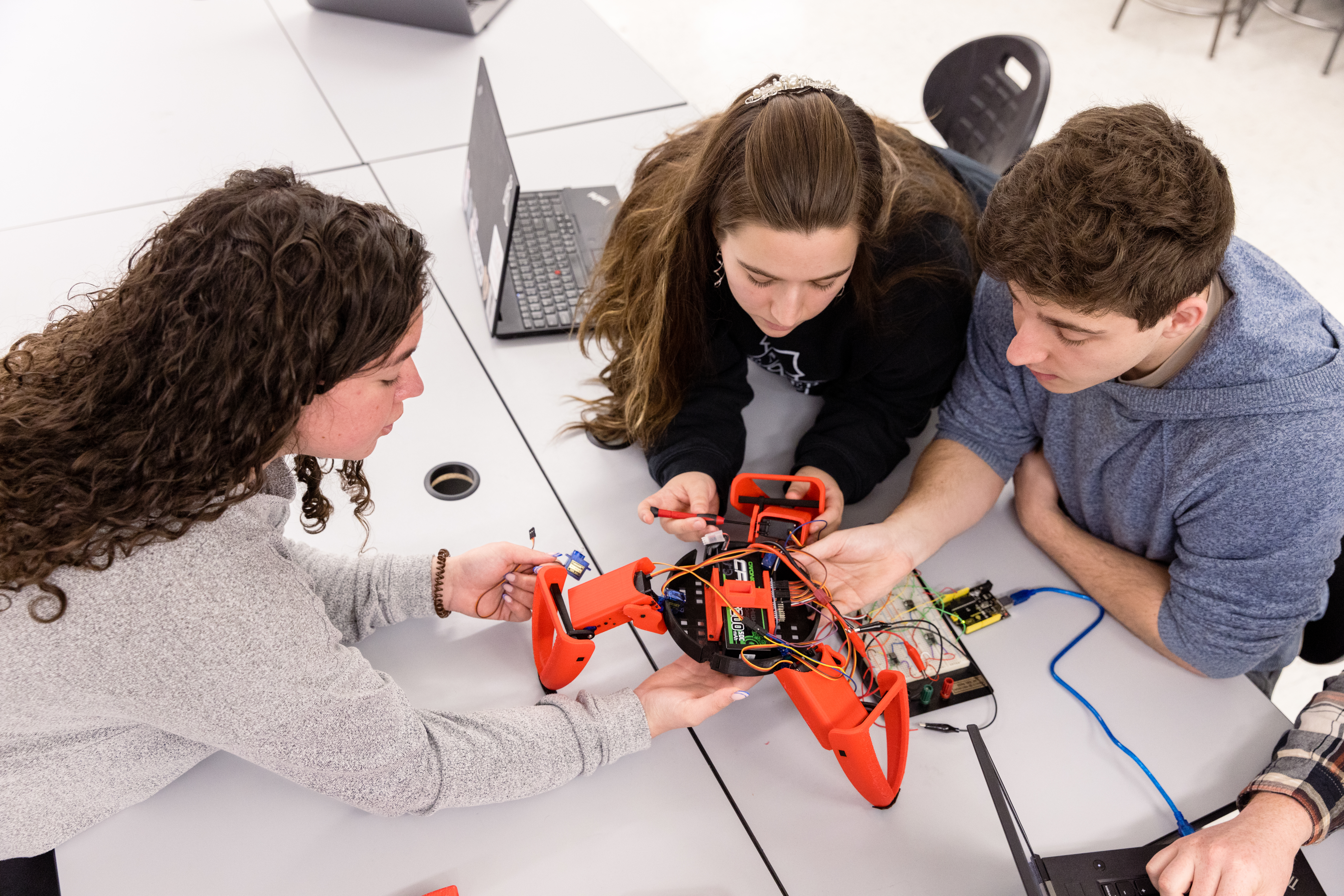
Why National Engineers Week Matters at NCE
At NCE, National Engineers Week reflects the full engineering journey from foundational learning and experimentation to innovation, responsibility, and professional identity. Each event highlights a different way engineers transform the world and prepare for impactful careers.
Students in the Newark College of Engineering Co-op programs need to fulfill the following expectations (listed below) upon completion of their Co-op experience:
For confirmation and further details of what assignments you should complete for your Co-op course, contact your Co-op Faculty Advisor.
- For the academic department, students will prepare a slide Deck (e.g., PowerPoint) describing the work conducted during their Co-op experience and how it relates to their academic studies. This presentation will be submitted by the student to their Co-op Faculty Advisor at the end of the Co-op semester.
- For Career Development Services, students will complete the Final Evaluation, which is sent to the student by email.
- By Employers, a Final Evaluation is completed. The student's Co-op supervisor will receive an email that will contain an evaluation form they fill out to evaluate the student's performance
Accreditation Introductory Statement
The Mechanical Engineering (B.S.) program at the New Jersey Institute of Technology (NJIT) is accredited by the Engineering Accreditation Commission of ABET, under the commission's General Criteria and Program Criteria for Mechanical and Similarly Named Engineering Programs.
ME Program Educational Objectives
The undergraduate program leads to a Bachelor of Science degree in Mechanical Engineering (ME), producing graduates who will, within 3-5 years:
- Graduates will meet or exceed the expectations of employers of mechanical engineers
- Graduates will pursue professional growth and development
- Graduates will pursue leadership positions in their profession and/or communities
ME Student Outcomes
Students from the ME program will attain (by the time of graduation):
- an ability to identify, formulate, and solve complex engineering problems by applying principles of engineering, science, and mathematics
- an ability to apply engineering design to produce solutions that meet specified needs with consideration of public health, safety, and welfare, as well as global, cultural, social, environmental, and economic factors
- an ability to communicate effectively with a range of audiences
- an ability to recognize ethical and professional responsibilities in engineering situations and make informed judgments, which must consider the impact of engineering solutions in global, economic, environmental, and societal contexts
- an ability to function effectively on a team whose members together provide leadership, create a collaborative environment, establish goals, plan tasks, and meet objectives
- an ability to develop and conduct appropriate experimentation, analyze and interpret data, and use engineering judgment to draw conclusions
- an ability to acquire and apply new knowledge as needed, using appropriate learning strategies
| Academic Year | FTFTU | Transfer | Total Enrollment | Degrees Awarded |
| 2024-2025 | 170 | 65 | 775 | 145* |
| 2023-2024 | 177 | 74 | 772 | 151 |
| 2022-2023 | 130 | 59 | 810 | 207 |
| 2021-2022 | 127 | 70 | 915 | 246 |
| 2020-2021 | 123 | 114 | 993 | 247 |
| *Complete count of the degrees awarded for the current year (2024-2025) will be available after September 2025. |
The detailed curriculum and degree requirements for the B.S. in Mechanical Engineering are available in the BS in Mechanical Engineering Catalog.
Visit the NCE Programs ABET Accreditation for more information.
Accreditation Introductory Statement
The Industrial Engineering (B.S.) program at the New Jersey Institute of Technology (NJIT) is accredited by the Engineering Accreditation Commission of ABET, under the commission's General Criteria and Program Criteria for Industrial and Similarly Named Engineering Programs.
IE Program Educational Objectives
The undergraduate program leads to a Bachelor of Science degree in Industrial Engineering (IE), producing graduates who will, within 3-5 years:
- Program graduates use the fundamental principles and major areas of Industrial Engineering in their professional practice.
- Program graduates are life-long learners, pursuing graduate education and professional growth in Industrial Engineering and related fields.
- Program graduates become seasoned professionals through diverse career paths in a variety of industries.
IE Student Outcomes
Students from the IE program will attain (by the time of graduation):
- an ability to identify, formulate, and solve complex engineering problems by applying principles of engineering, science, and mathematics
- an ability to apply engineering design to produce solutions that meet specified needs with consideration of public health, safety, and welfare, as well as global, cultural, social, environmental, and economic factors
- an ability to communicate effectively with a range of audiences
- an ability to recognize ethical and professional responsibilities in engineering situations and make informed judgments, which must consider the impact of engineering solutions in global, economic, environmental, and societal contexts
- an ability to function effectively on a team whose members together provide leadership, create a collaborative environment, establish goals, plan tasks, and meet objectives
- an ability to develop and conduct appropriate experimentation, analyze and interpret data, and use engineering judgment to draw conclusions
- an ability to acquire and apply new knowledge as needed, using appropriate learning strategies
| Academic Year | FTFTU | Transfer | Total Enrollment | Degrees Awarded |
| 2024-2025 | 6 | 8 | 60 | 22* |
| 2023-2024 | 8 | 5 | 62 | 24 |
| 2022-2023 | 5 | 5 | 69 | 22 |
| 2021-2022 | 10 | 6 | 94 | 39 |
| 2020-2021 | 11 | 4 | 82 | 16 |
| *Complete count of the degrees awarded for the current year (2024-2025) will be available after September 2025. |
The detailed curriculum and degree requirements for the B.S. in Industrial Engineering are available in the BS in Industrial Engineering Catalog.
Visit the NCE Programs ABET Accreditation Main Page for more information.
Accreditation Introductory Statement
The Electrical Engineering (B.S.) program at the New Jersey Institute of Technology (NJIT) is accredited by the Engineering Accreditation Commission of ABET, under the commission's General Criteria and Program Criteria for Electrical, Computer, Communications, Telecommunication(s), and Similarly Named Engineering Programs.
EE Program Educational Objectives
The undergraduate program leads to a Bachelor of Science degree in Electrical Engineering (EE), producing graduates who will, within 3-5 years:
- Technical Expertise & Problem-Solving – Graduates will demonstrate proficiency in electrical engineering fundamentals and apply them to solve complex challenges across diverse domains.
- Professional Growth & Leadership – Graduates will advance in their careers by assuming leadership roles, managing projects, and driving technological innovation.
- Lifelong Learning & Adaptability – Graduates will engage in continuous professional development to stay current with emerging technologies and industry trends.
- Ethical and Societal Responsibility – Graduates will practice ethical decision-making and consider societal, legal, and global impacts when designing and implementing electrical and computing engineering solutions.
- Effective Communication & Collaboration – Graduates will work effectively in teams, communicate technical concepts to various audiences, and collaborate across disciplines
EE Student Outcomes
Students from the EE program will attain (by the time of graduation):
- an ability to identify, formulate, and solve complex engineering problems by applying principles of engineering, science, and mathematics
- an ability to apply engineering design to produce solutions that meet specified needs with consideration of public health, safety, and welfare, as well as global, cultural, social, environmental, and economic factors
- an ability to communicate effectively with a range of audiences
- an ability to recognize ethical and professional responsibilities in engineering situations and make informed judgments, which must consider the impact of engineering solutions in global, economic, environmental, and societal contexts
- an ability to function effectively on a team whose members together provide leadership, create a collaborative environment, establish goals, plan tasks, and meet objectives
- an ability to develop and conduct appropriate experimentation, analyze and interpret data, and use engineering judgment to draw conclusions
- an ability to acquire and apply new knowledge as needed, using appropriate learning strategies
| Academic Year | FTFTU | Transfer | Total Enrollment | Degrees Awarded |
| 2024-2025 | 60 | 44 | 332 | 71* |
| 2023-2024 | 58 | 32 | 288 | 50 |
| 2022-2023 | 52 | 36 | 275 | 63 |
| 2021-2022 | 43 | 33 | 314 | 90 |
| 2020-2021 | 31 | 33 | 322 | 83 |
| *Complete count of the degrees awarded for the current year (2024-2025) will be available after September 2025. |
The detailed curriculum and degree requirements for the B.S. in Electrical Engineering are available in the BS in Electrical Engineering Catalog.
Visit the NCE Programs ABET Accreditation Main Page for more information.
Accreditation Introductory Statement
The Computer Engineering (B.S.) program at the New Jersey Institute of Technology (NJIT) is accredited by the Engineering Accreditation Commission of ABET, under the commission’s General Criteria and Program Criteria for Electrical, Computer, Communications, Telecommunication(s), and Similarly Named Engineering Programs.
CoE Program Educational Objectives
The undergraduate program leads to a Bachelor of Science degree in Computer Engineering (CoE), producing graduates who will, within 3-5 years:
- Technical Expertise & Problem-Solving – Graduates will demonstrate proficiency in computer engineering fundamentals and apply them to solve complex challenges across diverse domains.
- Professional Growth & Leadership – Graduates will advance in their careers by assuming leadership roles, managing projects, and driving technological innovation.
- Lifelong Learning & Adaptability – Graduates will engage in continuous professional development to stay current with emerging technologies and industry trends.
- Ethical and Societal Responsibility – Graduates will practice ethical decision-making and consider societal, legal, and global impacts when designing and implementing electrical and computing engineering solutions.
- Effective Communication & Collaboration – Graduates will work effectively in teams, communicate technical concepts to various audiences, and collaborate across disciplines
CoE Student Outcomes
Students from the CoE program will attain (by the time of graduation):
- an ability to identify, formulate, and solve complex engineering problems by applying principles of engineering, science, and mathematics
- an ability to apply engineering design to produce solutions that meet specified needs with consideration of public health, safety, and welfare, as well as global, cultural, social, environmental, and economic factors
- an ability to communicate effectively with a range of audiences
- an ability to recognize ethical and professional responsibilities in engineering situations and make informed judgments, which must consider the impact of engineering solutions in global, economic, environmental, and societal contexts
- an ability to function effectively on a team whose members together provide leadership, create a collaborative environment, establish goals, plan tasks, and meet objectives
- an ability to develop and conduct appropriate experimentation, analyze and interpret data, and use engineering judgment to draw conclusions
- an ability to acquire and apply new knowledge as needed, using appropriate learning strategies
| Academic Year | FTFTU | Transfer | Total Enrollment | Degrees Awarded |
| 2024-2025 | 82 | 28 | 360 | 65* |
| 2023-2024 | 92 | 16 | 360 | 53 |
| 2022-2023 | 97 | 19 | 354 | 56 |
| 2021-2022 | 94 | 22 | 372 | 48 |
| 2020-2021 | 67 | 21 | 371 | 66 |
| *Complete count of the degrees awarded for the current year (2024-2025) will be available after September 2025. |
The detailed curriculum and degree requirements for the B.S. in Computer Engineering are available in the BS in Computer Engineering Catalog.
Visit the NCE Programs ABET Accreditation Main Page for more information.
Accreditation Introductory Statement
The Civil Engineering (B.S.) program at The New Jersey Institute of Technology (NJIT) is accredited by the Engineering Accreditation Commission of ABET, under the commission’s General Criteria and Program Criteria for Civil and Similarly Named Engineering Programs.
CE Program Educational Objectives
The undergraduate program leads to a Bachelor of Science degree in Civil Engineering (CE), producing graduates who will, within 3-5 years:
- Engineering Practice: Alumni will successfully engage in the ethical practice of civil engineering within industry, government, and private practice, working toward safe, practical, resilient, and sustainable solutions in a wide array of technical specialties including construction, environmental, geotechnical, structural, transportation, and water resources.
- Professional Growth: Alumni will advance their skills through professional growth and development activities such as graduate study in engineering, research and development, professional registration, and continuing education; some graduates will transition into other professional fields such as academia, business, and law through further education.
- Service: Alumni will perform service to society and the engineering profession through membership and participation in professional societies, government, educational institutions, civic organizations, charitable giving, and other humanitarian endeavors.
CE Student Outcomes
Students from the CE program will attain (by the time of graduation):
- an ability to identify, formulate, and solve complex engineering problems by applying principles of engineering, science, and mathematics
- an ability to apply engineering design to produce solutions that meet specified needs with consideration of public health, safety, and welfare, as well as global, cultural, social, environmental, and economic factors
- an ability to communicate effectively with a range of audiences
- an ability to recognize ethical and professional responsibilities in engineering situations and make informed judgments, which must consider the impact of engineering solutions in global, economic, environmental, and societal contexts
- an ability to function effectively on a team whose members together provide leadership, create a collaborative environment, establish goals, plan tasks, and meet objectives
- an ability to develop and conduct appropriate experimentation, analyze and interpret data, and use engineering judgment to draw conclusions
- an ability to acquire and apply new knowledge as needed, using appropriate learning strategies
| Academic Year | FTFTU | Transfer | Total Enrollment | Degrees Awarded |
| 2024-2025 | 78 | 49 | 450 | 87* |
| 2023-2024 | 77 | 52 | 491 | 139 |
| 2022-2023 | 74 | 47 | 570 | 180 |
| 2021-2022 | 66 | 62 | 636 | 193 |
| 2020-2021 | 71 | 87 | 690 | 192 |
| *Complete count of the degrees awarded for the current year (2024-2025) will be available after September 2025. |
The detailed curriculum and degree requirements for the B.S. in Civil Engineering are available in the BS in Civil Engineering Catalog.
Visit the NCE Programs ABET Accreditation Main Page for more information.
Accreditation Introductory Statement
The Chemical Engineering (B.S.) program at the New Jersey Institute of Technology (NJIT) is accredited by the Engineering Accreditation Commission of ABET, under the commission's General Criteria and Program Criteria for Chemical, Biochemical, Biomolecular and Similarly Named Engineering Programs.
ChE Program Educational Objectives
The undergraduate program leads to a Bachelor of Science degree in Chemical Engineering (ChE), producing graduates who will, within 3-5 years:
- Engineering Practice: Graduates of our program are successfully engaged in the practice of chemical engineering within the industry, academe and government working in a wide array of technical specialties including but not limited to process and plant design operations.
- Professional Growth: Graduates of our program advance their skills through professional growth and development activities such as graduate study in engineering or complementary disciplines, and continuing education; some graduates will transition into other professional fields such as business, law, and medicine through further education.
- Service: Graduates of our program perform service to society and the engineering profession through participation in professional societies, government, civic organizations, and humanitarian endeavors.
ChE Student Outcomes
Students from the ChE program will attain (by the time of graduation):
- an ability to identify, formulate, and solve complex engineering problems by applying principles of engineering, science, and mathematics
- an ability to apply engineering design to produce solutions that meet specified needs with consideration of public health, safety, and welfare, as well as global, cultural, social, environmental, and economic factors
- an ability to communicate effectively with a range of audiences
- an ability to recognize ethical and professional responsibilities in engineering situations and make informed judgments, which must consider the impact of engineering solutions in global, economic, environmental, and societal contexts
- an ability to function effectively on a team whose members together provide leadership, create a collaborative environment, establish goals, plan tasks, and meet objectives
- an ability to develop and conduct appropriate experimentation, analyze and interpret data, and use engineering judgment to draw conclusions
- an ability to acquire and apply new knowledge as needed, using appropriate learning strategies.
| Academic Year | FTFTU | Transfer | Total Enrollment | Degrees Awarded |
| 2024-2025 | 54 | 12 | 237 | 57* |
| *2023-2024 | 31 | 15 | 214 | 51 |
| 2022-2023 | 36 | 12 | 224 | 51 |
| 2021-2022 | 34 | 14 | 268 | 70 |
| 2020-2021 | 31 | 25 | 307 | 79 |
| *Complete count of the degrees awarded for the current year (2024-2025) will be available after September 2025. |
The detailed curriculum and degree requirements for the B.S. in Chemical Engineering are available in the BS in Chemical Engineering Catalog.
Visit the NCE Programs ABET Accreditation Main Page for more information.
Accreditation Introductory Statement
The Biomedical Engineering (B.S.) program at the New Jersey Institute of Technology (NJIT) is accredited by the Engineering Accreditation Commission of ABET, under the commission's General Criteria and Program Criteria for Bioengineering and Biomedical and Similarly Named Engineering Programs.
BME Program Educational Objectives
The undergraduate program leads to a Bachelor of Science degree in Biomedical Engineering (BME), producing graduates with the following attributes in their career:
Objective A) Students will be prepared for productive careers in the biomedical engineering field and embark on broad paths in industry (medical device / pharmaceutical / AI as it applies to BME and digital health), professional and graduate education (including medical school and research), or biomedical development, operations, and leadership.
Objective B) As professionals, our alumni will demonstrate the following traits:
- Integrators: BME graduates will be able to translate and effectively apply their fundamental knowledge of sciences, mathematics, liberal arts, and engineering analysis into actions that add value to industry by solving a wide range of problems and identifying emerging opportunities - especially those related to medicine and biology.
- Continued professional growth: BME graduates will independently advance their education and skills through professional growth and development opportunities by participation in professional societies, continuing education, or graduate study.
- Leadership through engagement: BME graduates will engage in leadership and professional service to improve the biomedical field through engagement in local, national, or global communities.
BME Student Outcomes
Students from the BME program will attain (by the time of graduation):
- an ability to identify, formulate, and solve complex engineering problems by applying principles of engineering, science, and mathematics
- an ability to apply engineering design to produce solutions that meet specified needs with consideration of public health, safety, and welfare, as well as global, cultural, social, environmental, and economic factors
- an ability to communicate effectively with a range of audiences
- an ability to recognize ethical and professional responsibilities in engineering situations and make informed judgments, which must consider the impact of engineering solutions in global, economic, environmental, and societal contexts
- an ability to function effectively on a team whose members together provide leadership, create a collaborative and inclusive environment, establish goals, plan tasks, and meet objectives
- an ability to develop and conduct appropriate experimentation, analyze and interpret data, and use engineering judgment to draw conclusions
- an ability to acquire and apply new knowledge as needed, using appropriate learning strategies
| Academic Year | FTFTU | Transfer | Total Enrollment | Degrees Awarded |
| 2024-2025 | 67 | 13 | 339 | 89* |
| 2023-2024 | 81 | 13 | 351 | 70 |
| 2022-2023 | 81 | 13 | 380 | 101 |
| 2021-2022 | 71 | 16 | 396 | 93 |
| 2020-2021 | 75 | 18 | 417 | 89 |
| *Complete count of the degrees awarded for the current year (2024-2025) will be available after September 2025. |
The detailed curriculum and degree requirements for the B.S. in Biomedical Engineering are available in the BS in Biomedical Engineering Catalog.
Visit NCE Programs ABET Accreditation Main Page for more information.